


Size for Worst Day Conditions: 12V vs 24V Trolling Motor Watt Hours
For a kayak, canoe, or small jon boat on calm water, a 12V trolling motor is plenty. For a 17 to 20 foot bass or bay boat, or any day with real wind and current, 24V gives you the thrust margin and control you need. The difference comes down to motor thrust and how many batteries you’re wiring together, and Banshee Batteries carries options for either setup.
TL;DR:
- 24V systems offer significantly higher thrust, typically between 70 to 101 pounds, compared to 30 to 65 pounds for 12V motors.
- Running a 24V setup generally extends runtime to 6 to 8 hours on two 100Ah batteries, while a 12V motor usually lasts 4 to 5 hours on a single 100Ah battery.
- 24V motors operate cooler and handle load better because voltage and current are balanced, reducing heat and voltage sag during extended use.
- Wiring a 24V system requires matched batteries in series and heavier gauge wiring, which increases installation complexity and cost.
- Upgrading to 24V makes the most sense for boats over 16 feet, especially in windy or current-heavy conditions, where extra thrust and control are necessary.
Table of Contents
- 12V vs 24V Trolling Motor Comparison at a Glance
- How Does Voltage Affect Trolling Motor Power and Heat?
- How Long Will a 12V or 24V Trolling Motor Battery Last?
- Which Boat Sizes and Conditions Call for 24V?
- What Wiring and Charging Does a 24V Setup Need?
- Is a 24V Upgrade Worth the Extra Cost?
- Why Battery Choice Matters as Much as Voltage
- What a Simple Voltage Drop Test Tells You
- Upgrade Your Trolling Motor Battery With Banshee Batteries
- Sources
12V vs 24V Trolling Motor Comparison at a Glance
The fastest way to see where you land is to look at the numbers side by side. Thrust, battery count, and runtime tend to move together, so once you know your boat’s size and typical conditions, the right column usually picks itself.
| Criteria | 12V | 24V |
|---|---|---|
| Typical thrust range | ~30 to 65 lb | ~70 to 101 lb |
| Batteries required | 1 | 2 (wired in series) |
| Typical runtime (moderate use) | 4 to 5 hours on a 100Ah battery | 6 to 8 hours on two 100Ah batteries |
| Installation complexity | Simple, single-battery hookup | Moderate; matched batteries, heavier wire, dedicated charger |
| Best for | Kayaks, canoes, jon boats, calm water | Bass boats, bay boats, wind, current, spot-lock use |
Three things fall out of that table pretty quickly:
- 24V systems commonly push 70 to 101 pounds of thrust versus 12V’s 30 to 65 pound range, which is the real driver of the voltage decision, not brand preference.
- Runtime scales with battery count more than with voltage alone. A 24V rig runs longer mainly because it’s carrying two batteries, not because 24V is inherently more efficient.
- Installation jumps in complexity the moment you add a second battery, even before you touch wiring gauge or chargers.
If your boat and conditions sit right on the fence between rows, treat wind and current as the tiebreaker, not boat length alone.
How Does Voltage Affect Trolling Motor Power and Heat?
Voltage and current trade off to produce the same power, and that trade-off is the entire reason 24V motors run cooler and hold up better under load. Power in watts equals volts multiplied by amps, so a motor pulling 600 watts needs 50 amps at 12V but only 25 amps at 24V. Half the current means half the heat in your wiring and half the strain on your motor’s internal components.
That matters in practice, not just on paper. Lower current draw at 24V translates directly into:
- Less voltage sag when you hold the throttle down for a long push against current
- Cooler wiring and connectors, even during extended spot-lock use
- More consistent thrust output when the motor is working hard, not just idling along
Under-volting a motor forces it to draw excessive current to compensate, which generates extra heat and shortens the life of both the motor and its controller. That’s not a minor footnote. It’s the mechanism behind most “my motor died early” complaints from anglers who undersized their system for the conditions they actually fish.
The practical upshot: if you’re frequently running your motor near max throttle, holding position in wind, or using spot-lock for long stretches, the reduced current draw of a 24V system keeps voltage more stable under sustained load. A 12V motor doing the same job simply works harder to deliver the same thrust, and that extra strain shows up over a season, not overnight.
How Long Will a 12V or 24V Trolling Motor Battery Last?
Battery configuration determines both your voltage and how long you’ll fish before recharging, and the two are connected in a way a lot of first-time buyers miss. Wiring batteries in series adds their voltages together while keeping capacity the same, which is how two 12V 100Ah batteries become one 24V 100Ah bank instead of a 12V 200Ah bank. Parallel wiring does the opposite: voltage stays the same, capacity adds up.
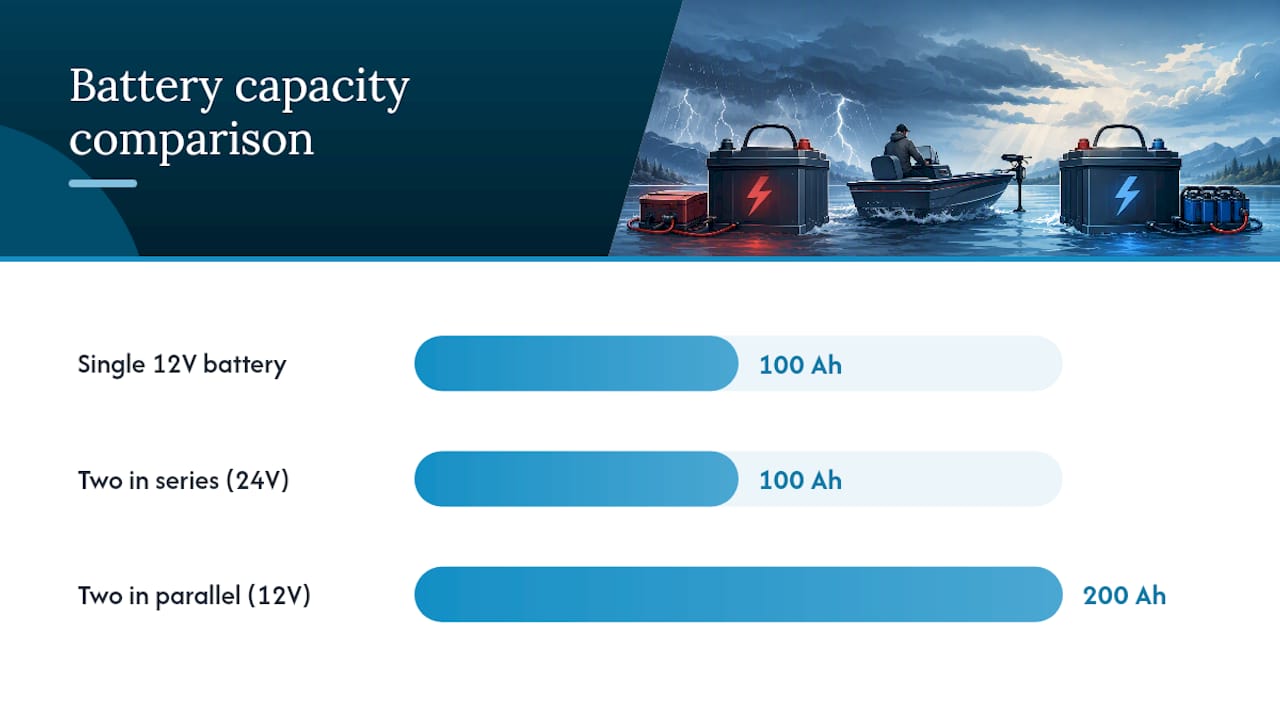
Real-world runtime examples make this concrete. A 12V 55 lb motor on a single 100Ah battery typically runs 4 to 5 hours at moderate use, while a 24V motor wired from two 100Ah batteries in series generally extends runtime compared to a single battery. That’s not because 24V batteries store more energy. It’s because you’re carrying twice the battery hardware to get there.
Chemistry changes the math further:
- Lithium (LiFePO4) batteries deliver roughly 90% usable capacity, compared to about 50% for AGM or lead-acid, meaning a 100Ah lithium battery gives you nearly double the usable runtime of a 100Ah AGM of the same rating.
- Lithium batteries are significantly lighter than equivalent AGM batteries, which matters more on a 24V setup where you’re already carrying two batteries.
- AGM batteries tolerate deeper discharge cycles worse over time; lithium holds its cycle life far longer, which shows up as fewer replacement purchases over the years you own the boat.
Pro Tip: If you’re running a 24V system, always pair identical batteries, same age, same capacity, same chemistry. Mismatched batteries in series degrade unevenly, and the weaker one drags the whole bank down faster than either would fail on its own.
For anglers weighing lithium against AGM for a trolling motor bank, our guide on sizing lithium batteries for trolling motors walks through the amp-hour math in more detail.
Which Boat Sizes and Conditions Call for 24V?
Boat size is the starting point, but it’s not the whole story. Wind, current, and how you actually fish matter just as much as length on the hull.
- Kayaks, canoes, and small jon boats under 14 feet on calm lakes and ponds rarely need more than 30 to 55 lb of thrust, which puts them squarely in 12V territory.
- Small aluminum and fiberglass boats in the 14 to 16 foot range on lakes with light current still tend to do fine on a strong 12V motor, unless you’re regularly fighting wind.
- 17 to 20 foot bass and bay boats carrying two or three anglers, a livewell, and tackle gear are where 24V starts earning its keep, especially if you use spot-lock or fish current-heavy rivers.
- Boats over 20 feet or tournament rigs running heavier loads and demanding all-day reliability often justify stepping up to 36V, which is a separate conversation but worth knowing exists.
Before you buy, run through a short worst-day checklist rather than sizing for your calmest outing:
- What’s the fully loaded weight of your boat with crew, gear, and a full livewell?
- What’s the worst wind or current you realistically fish in, not the average day?
- Do you rely on spot-lock or need to hold position for extended stretches?
Pro Tip: Size your motor for the toughest conditions you fish, not the easiest ones. A motor that handles a calm Tuesday morning fine can get overwhelmed on a windy Saturday, and that’s exactly when you need reliable thrust most.
Anglers often upgrade to 24V for the control margin during spot-lock and holding against wind, not purely for longer runtime, which is worth remembering if you’re on the fence about whether the extra battery and wiring are worth it.
The general rule: if you’re ever unsure between two categories, size up. Underpowering a motor for your actual conditions costs you more in frustration and premature wear than the modest extra cost of the next voltage tier up.
What Wiring and Charging Does a 24V Setup Need?
Stepping up to 24V means wiring two batteries in series, positive terminal of one to the negative terminal of the next, then drawing your motor’s power leads from the remaining open positive and negative terminals. It’s not complicated, but it does require attention to a few details that a 12V single-battery hookup never forces you to think about.
- Use two batteries of the same age, capacity, and chemistry. Mismatched batteries in series wear unevenly and shorten the life of the whole bank.
- Most 24V trolling motor installations use appropriately gauged wiring, often in the range of 6 to 8 AWG for short runs, though you should always check your specific motor’s manual since longer cable runs may need heavier gauge to limit voltage drop.
- Fuse both the positive lead and any accessory circuits appropriately for the amperage your motor draws.
- Mount batteries in secure trays with adequate ventilation, particularly for AGM chemistries, and keep terminals clean to prevent corrosion.
Charging is where a lot of first-time 24V owners get tripped up. You have two real options: a dedicated 24V charger that charges the series bank as a unit, or a dual-bank 12V charger with separate outputs that charges each battery independently while they’re still wired in series for use. Either works, but you cannot simply charge one battery in the pair and expect the bank to balance itself.
Pro Tip: When placing two batteries for a 24V system, don’t just tuck them wherever there’s room. Uneven weight distribution from asymmetrical battery placement can subtly affect boat trim, so check your motor manufacturer’s tray location recommendations before you drill anything.
Our guide to marine battery bank setup covers tray placement and wiring layout in more depth if you’re planning the upgrade yourself.
Is a 24V Upgrade Worth the Extra Cost?
The honest answer is that it depends on how often you actually need the extra thrust, not just whether you can afford it. A 24V motor itself often costs more than an equivalent 12V unit, and you’re also buying a second battery, heavier gauge wiring, and possibly a new charger. None of those costs are enormous individually, but they add up faster than most first-time buyers expect.
- Motor price differences between comparable 12V and 24V models may be several hundred dollars, though this varies by brand and thrust rating.
- A second battery is the most visible added cost, but wiring, fusing, and a charger upgrade often add up to more than the battery itself.
- Lithium batteries cost more upfront than AGM but weigh significantly less and last far more charge cycles, which can pay back the price difference within a few seasons for anglers who fish often.
The upgrade is worth it when you’re regularly pushing your current motor to its limit, fishing in wind or current more days than not, or relying on spot-lock for extended stretches. It’s not worth it if you’re fishing calm water a few times a season and your 12V setup has never left you wanting more thrust. Our comparison of marine lithium versus AGM breaks down the long-term economics in more detail.
Why Battery Choice Matters as Much as Voltage
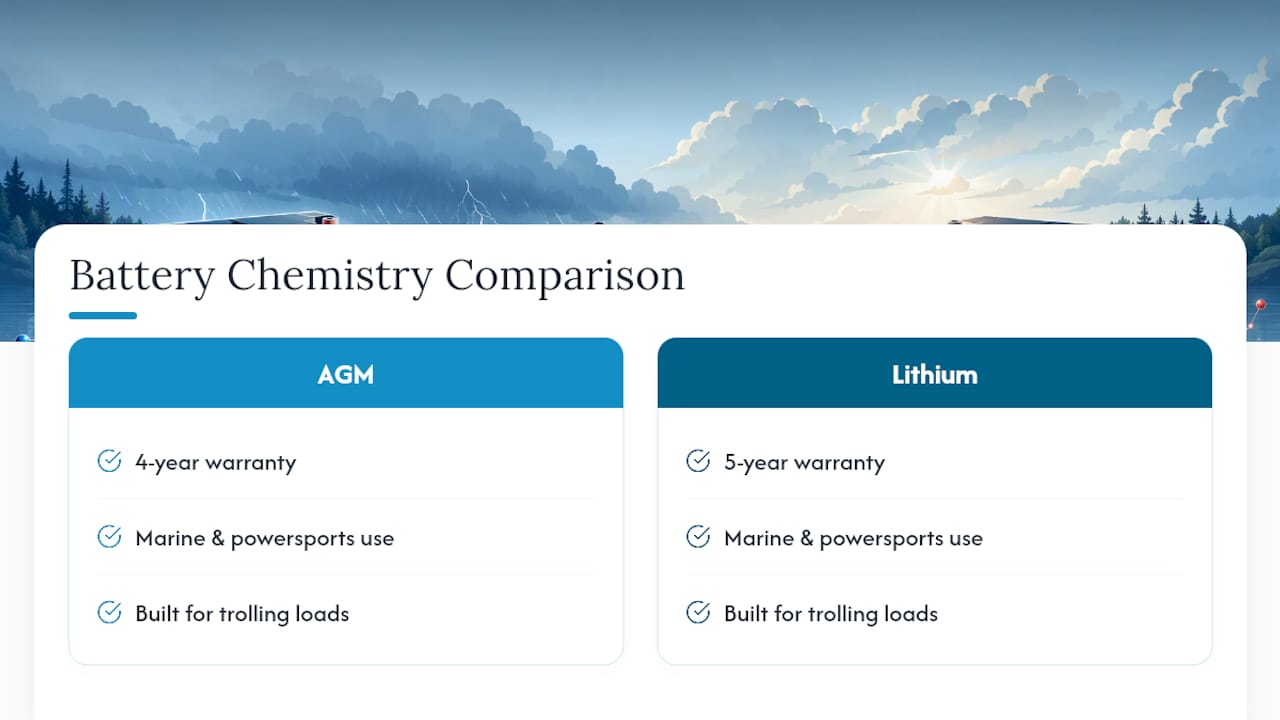
Choosing the right voltage only gets you halfway there. The battery behind it determines whether that voltage actually holds up on the water. Banshee Batteries has spent over 20 years building AGM and lithium batteries for marine and powersports use, backed by a 4-year warranty on AGM batteries and a 5-year warranty on lithium marine batteries, the kind of coverage that reflects confidence in how the batteries perform under real trolling motor loads, not just a lab bench.
If you’re still working out how many amp-hours your setup needs, our best boat batteries for trolling motors guide breaks down chemistry choices by use case.
What a Simple Voltage Drop Test Tells You
A friend of mine ran a 12V motor on a boat that had outgrown it for two seasons before admitting the throttle sagged every time the wind picked up. The fix wasn’t complicated: run your motor at holding throttle in real conditions and watch what the voltage does. If it drops noticeably and the thrust feels weaker than it did at idle, you’ve got your answer already.
— Donald
Upgrade Your Trolling Motor Battery With Banshee Batteries
If you’ve run the numbers above and landed on 24V, the batteries matter as much as the motor. Consider a lineup where lithium batteries provide higher usable capacity at lower weight, especially useful when carrying two batteries for a series setup. AGM batteries may suit those prioritizing budget and shorter usage periods.
The 12V 100Ah LiFePO4 lithium battery is a common building block for both 12V single-battery setups and 24V series banks, and the full lithium marine battery collection covers the range of capacities most trolling motor setups call for. Check your motor’s amp draw and your typical trip length, then match a battery bank to your worst-day conditions rather than your average one.
Sources
- 12V vs 24V vs 36V Trolling Motor Systems Explained | NVN Marine
- 12 Volt Vs 24 Volt Trolling Motor: Key Differences Explained
- 12V vs 24V Trolling Motor: Which is Best for Your Boat | Renogy US