


Limit LiFePO4 DoD to 80% and Prioritize SoC for Solar, RV & Marine
The safe working range for most LiFePO4 setups is 10% to 90% state of charge, an 80% depth of discharge that leaves a 10% buffer on each end. Push deeper only for emergencies. The bigger lever most people miss: average state of charge, not depth of discharge alone, drives most of the long-term capacity loss, so how long you sit at high charge matters as much as how deep you cycle. Let your battery management system top off to 100% occasionally so the cells stay balanced.
TL;DR:
- Cycling at high average state of charge, especially near 100%, accelerates capacity fade more than deep discharges at lower SoC levels.
- Most users should stick to an 80% DoD window (10% to 90% SoC) for daily use or adopt a 60% DoD window (20% to 80% SoC) for extended battery life.
- Pairing periodic full charges with proper BMS settings and amp-hour based SoC measurement helps prevent imbalance and premature degradation.
- High C-rate discharges and hot environments reduce safe DoD limits, necessitating cooling and derating in extreme conditions.
- Properly sizing a battery bank involves calculating daily energy use, dividing by effective capacity at your chosen DoD, and adding margins for inefficiencies and unexpected loads.
Table of Contents
- What Depth of Discharge Actually Measures in a LiFePO4 Battery
- The Practical DoD Windows Worth Actually Using
- Setting Up Your BMS and Inverter to Enforce Safe Discharge Limits
- Why Temperature and Discharge Rate Change Your Safe DoD
- Sizing a LiFePO4 Bank Around Your Chosen Discharge Depth
- Banshee Batteries on Turning DoD Research Into Real Settings
- Key Research Behind This LiFePO4 Discharge Guidance
- Find the Right LiFePO4 Battery for Your Discharge Habits
- Sources
What Depth of Discharge Actually Measures in a LiFePO4 Battery
Depth of discharge (DoD) is the percentage of a battery’s capacity you’ve used since the last full charge. State of charge (SoC) is the mirror image, the percentage still sitting in the cells. Discharge a 100Ah battery down to 30Ah remaining, and you’ve hit 70% DoD, 30% SoC.
That distinction sounds academic until you look at what actually kills a LiFePO4 cell over time. A peer-reviewed cycling study published in IOPscience found that cells cycled repeatedly at high average SoC windows, roughly 75% to 100%, faded faster than cells cycled across lower windows, even at similar depths of discharge. Spending most of your time near a full charge stresses the cell chemistry more than the act of discharging deeply does.
The mechanism comes down to two degradation modes: gradual loss of usable lithium inventory and iron dissolution from the cathode, both of which accelerate at high states of charge. Cycle-life numbers illustrate the stakes:
- LiFePO4 cells commonly deliver 3,000 to 6,000 cycles at around 80% DoD
- Cycling at 100% DoD regularly cuts that figure noticeably
- Shallower cycling, closer to 50% DoD, often pushes total cycle count well beyond 6,000
Statistic Callout: Two batteries discharged to the same 80% DoD can age at very different rates depending on how long each one lingers near full charge between cycles. That’s the SoC-window effect at work.
The Practical DoD Windows Worth Actually Using
Most experienced LiFePO4 users settle on one of two working windows, and the choice comes down to how much they value extra capacity versus extra years of service.
- 10% to 90% SoC (80% DoD). This is the everyday default for solar, RV, and marine setups. It gets you most of the nameplate capacity while avoiding the two riskiest zones: the flat, hard-to-measure top and the steep voltage cliff near empty.
- 20% to 80% SoC (60% DoD). The conservative choice. You sacrifice 20 percentage points of usable capacity in exchange for meaningfully less time spent in the high-fade zone above 80% SoC.
- Occasional 100% top-offs. Neither window above means never charging fully. A periodic full charge, maybe once every few weeks depending on use, gives the battery management system a chance to balance individual cells before drift becomes a problem.
The math on that reserve is straightforward. A 100Ah battery run at 80% DoD gives you 80Ah of usable energy per cycle. That’s the real trade: capacity today versus cycles over the life of the pack.
Setting Up Your BMS and Inverter to Enforce Safe Discharge Limits
Getting the numbers right on paper doesn’t matter if your system doesn’t enforce them. That comes down to three layers working together: the inverter or charge controller’s daily cutoff, the battery management system’s hard cutoff, and how you’re actually measuring state of charge.
- Set your inverter or DC load’s low-voltage disconnect as the everyday working limit, the boundary you want the system to respect in normal use.
- Treat the BMS cutoff as the backstop, the point it should only reach if something upstream fails.
- Use shunt-based, amp-hour counting for SoC instead of raw voltage. LiFePO4’s flat discharge curve makes voltage a poor proxy for charge level across most of the usable range, a detail confirmed by the way LiFePO4 cell voltage plateaus between roughly 20% and 90% SoC.
- Watch for cell drift. If one cell in a series pack consistently reads higher or lower than the others after a full charge, that’s an early sign of imbalance worth addressing before it worsens.
- Set alarm thresholds a few percentage points inside your working window, not at the BMS hard cutoff, so you get a warning before the system forces a shutdown.
Pair it with a shunt or switch to a battery management system that logs amp-hours directly.*
Charging habits matter here too. Reviewing how to charge a LiFePO4 battery correctly will save you from the two most common setup mistakes: undersized charge current and skipping the periodic full-charge balancing cycle entirely.
Why Temperature and Discharge Rate Change Your Safe DoD
Depth of discharge doesn’t operate in isolation. Heat and high current both interact with it, and ignoring either one undermines whatever DoD window you’ve chosen.

Recommended continuous discharge rates for LiFePO4 sit around 1C, with daily charge rates closer to 0.3C to 0.5C for best longevity. Push well past those figures and you generate more internal heat, which reduces the capacity you can actually pull from the pack before hitting a safe cutoff.
Temperature compounds the problem. An experimental study on an 8S5P LiFePO4 pack found that active cooling cut cell surface temperature by around 10°C and extended discharge time by between 7% and 16% under varied loads.
Practical mitigations that keep your DoD strategy intact:
- Add airflow or active cooling if your battery regularly discharges at high C-rates in a closed compartment
- Derate your working DoD slightly in hot climates or during summer peak loads
- Avoid storing a battery at high SoC in a hot environment, since elevated temperature and high charge combined accelerate degradation faster than either factor alone
Sizing a LiFePO4 Bank Around Your Chosen Discharge Depth
Once you’ve picked a DoD window, sizing the bank is a matter of working backward from your daily energy needs.
- Calculate your required usable energy in kWh per day (add up amp-hours drawn by each device, multiplied by system voltage).
- Divide that number by your usable fraction, 0.80 for an 80% DoD target or 0.60 for a 60% DoD target, to get the nameplate capacity you need.
- Add a margin for inverter efficiency losses, typically 5% to 10%, plus a reserve for cloudy days or unexpected loads.
That gap is exactly why most builders start with the 12V 100Ah LiFePO4 battery as a building block and stack units to hit their target rather than guessing at a single oversized pack.
Banshee Batteries on Turning DoD Research Into Real Settings
Cycle-life data only helps if it changes how your system is actually configured. That’s the gap Bansheebatteries built its lithium lineup around, backed by a 5-year warranty on lithium marine batteries that assumes the cells will be cycled hard, not babied.
When shopping for a pack, look for a battery management system that reports amp-hour-based state of charge, not just voltage, and supports a programmable low-voltage cutoff you can set independently from the BMS hard limit.
If you’re unsure how a specific model’s BMS handles balancing or cutoff thresholds, Banshee Batteries support can walk through the spec sheet with you before you buy.
— Donald
Key Research Behind This LiFePO4 Discharge Guidance
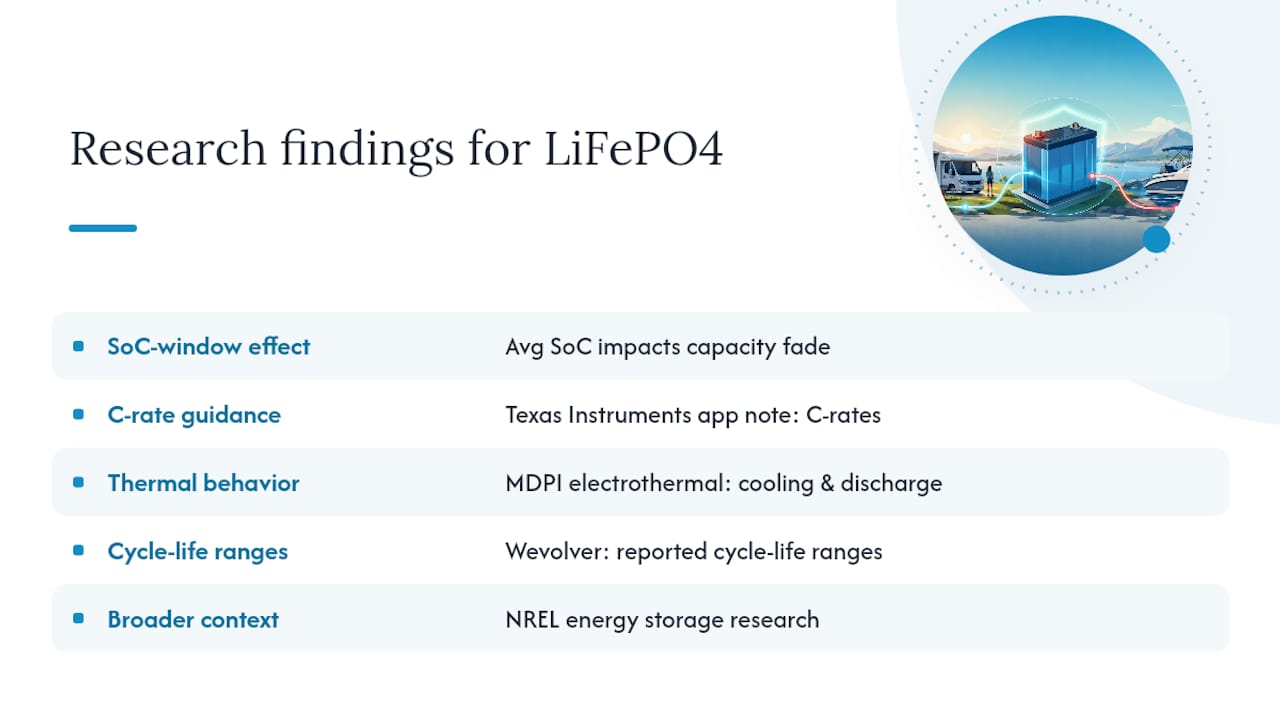
The SoC-window effect on capacity fade comes from a cycling study in IOPscience, the primary evidence that average state of charge outweighs DoD alone. Thermal behavior under load is documented in an MDPI electrothermal study on cooling and discharge time. C-rate recommendations draw on a Texas Instruments application note, and cycle-life ranges come from the Wevolver engineering guide. For broader storage-technology context, NREL’s energy storage research is worth bookmarking.
Find the Right LiFePO4 Battery for Your Discharge Habits
Bansheebatteries builds lithium packs specifically for the deep, repeated cycling that RV, marine, and powersports use demands, not the occasional light draw a generic lithium battery is designed around. That matters because a battery management system engineered for shallow consumer use often lacks the amp-hour counting and programmable cutoffs this guide just walked through.

If you’re sizing a new bank, start with the lithium marine battery lineup for boats and off-grid systems, or check the powersports lithium collection if you’re upgrading a motorcycle, ATV, or UTV. Compare amp-hour ratings against the sizing math above, then reach out to the Banshee team if you need help matching a specific model’s BMS settings to your target discharge window.
Sources
- The operation window of lithium iron phosphate/graphite cells affects their lifetime — IOPscience
- What is LiFePO4? — Wevolver engineering guide