


Battery Cycle Life: What It Means and Why It Matters
Battery cycle life is the number of complete charge and discharge cycles a battery can deliver before its capacity drops to roughly 80% of its original value — the point the industry treats as end of useful life. Once a battery crosses that threshold, it still works, but it holds noticeably less energy and becomes unreliable for demanding applications. That 80% benchmark is not arbitrary; it is the standard used by manufacturers, researchers, and regulatory bodies to define when a battery has reached the end of its rated service life.
Understanding battery cycle life is different from understanding battery life (how long a charge lasts on a given day) or calendar life (how long a battery ages over time regardless of use). Cycle life is specifically about wear from repeated charging and discharging. A battery rated for 500 cycles will reach that threshold faster if you drain it deeply every day than if you use it lightly.
Key concepts to keep in mind from the start:
- One full cycle equals 100% of the battery’s capacity discharged and recharged, but it does not have to happen in a single session.
- Partial discharges accumulate: drain 75% one day and 25% the next, and you have completed one full cycle.
- End of life is defined at roughly 80% remaining capacity, not zero function.
- Cycle life varies dramatically by battery chemistry, temperature, and how deeply you discharge each time.
- Knowing your battery’s cycle life helps you plan replacement costs and avoid unexpected failures.
Table of Contents
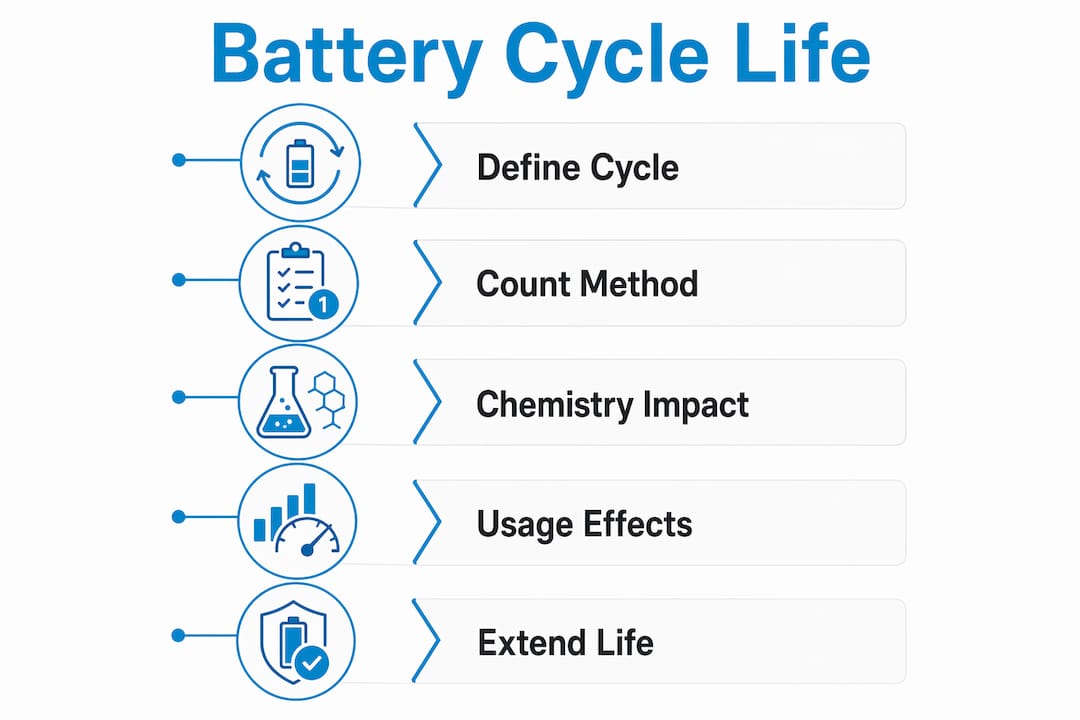
- What is battery cycle life, and how do you calculate it?
- How do different battery chemistries compare on cycle life?
- Why battery cycle life matters for your wallet and your equipment
- What factors reduce battery cycle life the fastest?
- How to extend your battery’s cycle life in practice
- What research reveals about battery degradation at the chemical level
- Bansheebatteries builds for cycle life from the ground up
- Key Takeaways
What is battery cycle life, and how do you calculate it?
Cycle counting is more nuanced than most people expect. A charge cycle is not simply one full drain from 100% to 0%. It is the cumulative discharge of an amount equal to 100% of the battery’s capacity. Use 75% of your battery one day, recharge it fully overnight, then use 25% the next day — those two days together count as one cycle. This matters because it means every partial use chips away at your total cycle count, even when you never fully drain the battery.
Depth of Discharge (DoD) plays a central role in how quickly cycles accumulate and how much damage each one causes. A battery discharged to 80% DoD (meaning 80% of its capacity is used) ages faster per cycle than one discharged to only 20% DoD. The relationship is not linear. Doubling the discharge depth does not simply double the wear; the degradation accelerates disproportionately at higher DoD levels. Manufacturers typically rate cycle life at a specific DoD, often 80% or 100%, so a battery rated for 500 cycles at 100% DoD may deliver 1,500 or more cycles if you consistently discharge it to only 50%.
A few practical points on cycle calculation:
- Manufacturer ratings assume consistent conditions: fixed temperature, fixed DoD, fixed charge rate. Real-world use rarely matches those conditions.
- Cycle life ratings are statistical averages, not guarantees for every individual cell.
- Partial cycles still count. A battery used at 30% DoD daily accumulates roughly one full cycle every three days.
- Energy throughput (total MWh delivered over a battery’s life) can be a more meaningful longevity metric than raw cycle count for storage systems, because it accounts for variable discharge depths.
How do different battery chemistries compare on cycle life?
Chemistry is the single largest determinant of how many cycles a battery can deliver. The atomic-level structure of the electrodes and electrolyte dictates how well a battery survives repeated expansion and contraction during charge and discharge.
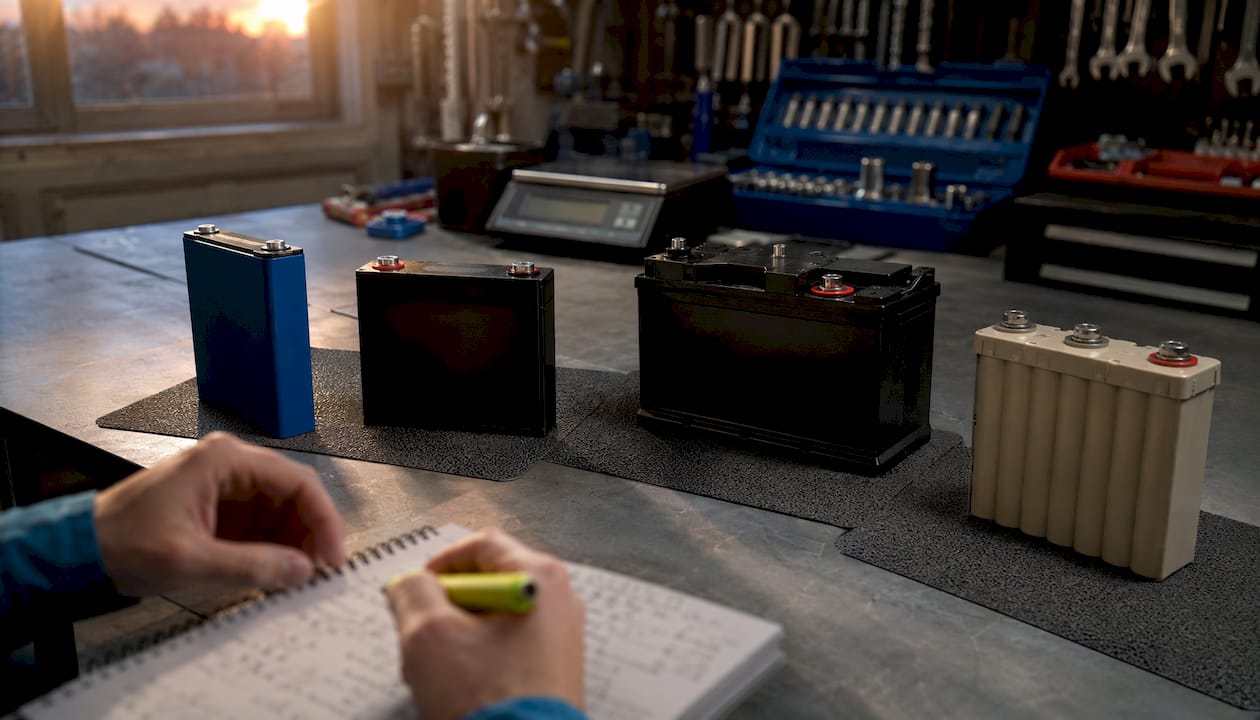
Lithium-Ion (Li-ion): Standard lithium-ion batteries, including lithium manganese oxide (LMO) chemistries, typically deliver around 500–1,000 cycles at 80% DoD before capacity falls below the 80% threshold. They are the dominant chemistry in consumer electronics and power tools.
Lithium Iron Phosphate (LiFePO4): LiFePO4 is the standout for longevity. Its chemistry is inherently more stable, and cycle lives exceeding 2,000 cycles are common, with many quality cells rated to 3,000 or more. The trade-off is slightly lower energy density compared to other lithium chemistries, but for marine, powersports, and stationary storage applications, the longevity advantage is decisive. You can read more about LiFePO4 chemistry specifics and why it outperforms standard lithium-ion for high-cycle applications.
Lead-Acid (AGM and flooded): Lead-acid batteries, including Absorbent Glass Mat (AGM) variants, typically deliver 200–500 cycles at 80% DoD. They are heavier and less cycle-efficient than lithium chemistries, but their lower upfront cost and proven reliability keep them relevant in automotive starting applications and backup power. Proper maintenance, including avoiding deep discharges, can push AGM batteries toward the higher end of their range.
Nickel-Cadmium (NiCd): NiCd batteries offer 500–1,000 cycles and handle deep discharges better than lead-acid, but cadmium’s toxicity and the “memory effect” (where partial discharges reduce effective capacity over time) have pushed them out of most modern applications.
Emerging chemistries like sodium-ion and solid-state lithium are attracting significant research attention for their potential to exceed current lithium-ion cycle life while reducing reliance on scarce materials. For a direct comparison of how lithium-ion and LiFePO4 stack up in real-world powersports and marine use, the chemistry differences translate directly into years of service life.
Why battery cycle life matters for your wallet and your equipment
Cycle life is not just a spec-sheet number. It determines how often you replace a battery, how much that replacement costs, and whether your equipment stays reliable when you need it most.
Consider a marine trolling motor running on a lead-acid battery with a typical cycle life significantly lower than LiFePO4 batteries. Under moderate weekend usage, the lead-acid battery lasts several years, whereas the LiFePO4 battery can last many times longer — far beyond the useful life of most boats. The higher upfront cost of lithium pays back quickly when you factor in replacement frequency.
For commercial and industrial applications, the math is even sharper. Solar energy storage systems, electric vehicle fleets, and backup power installations cycle batteries daily. At that rate, a battery with 500 cycles lasts less than two years; one with 3,000 cycles lasts over eight. The difference in total cost of ownership is substantial.
Reliability is the other side of the equation. A battery approaching end of cycle life does not fail cleanly. It loses capacity gradually, which means your device or vehicle runs for shorter periods before needing a recharge. In powersports and marine applications, that unpredictability is more than inconvenient — it can leave you stranded. Tracking cycle life and replacing batteries proactively keeps equipment performing within spec.
Cycle life also shapes maintenance practices. Knowing that your battery has a finite number of cycles encourages habits that extend that number: shallower discharges, stable temperatures, proper charging profiles. Understanding the difference between starting and deep cycle batteries is part of this picture, since each type is designed for a different cycle pattern.
What factors reduce battery cycle life the fastest?
Several variables accelerate battery aging, and most of them are within your control.
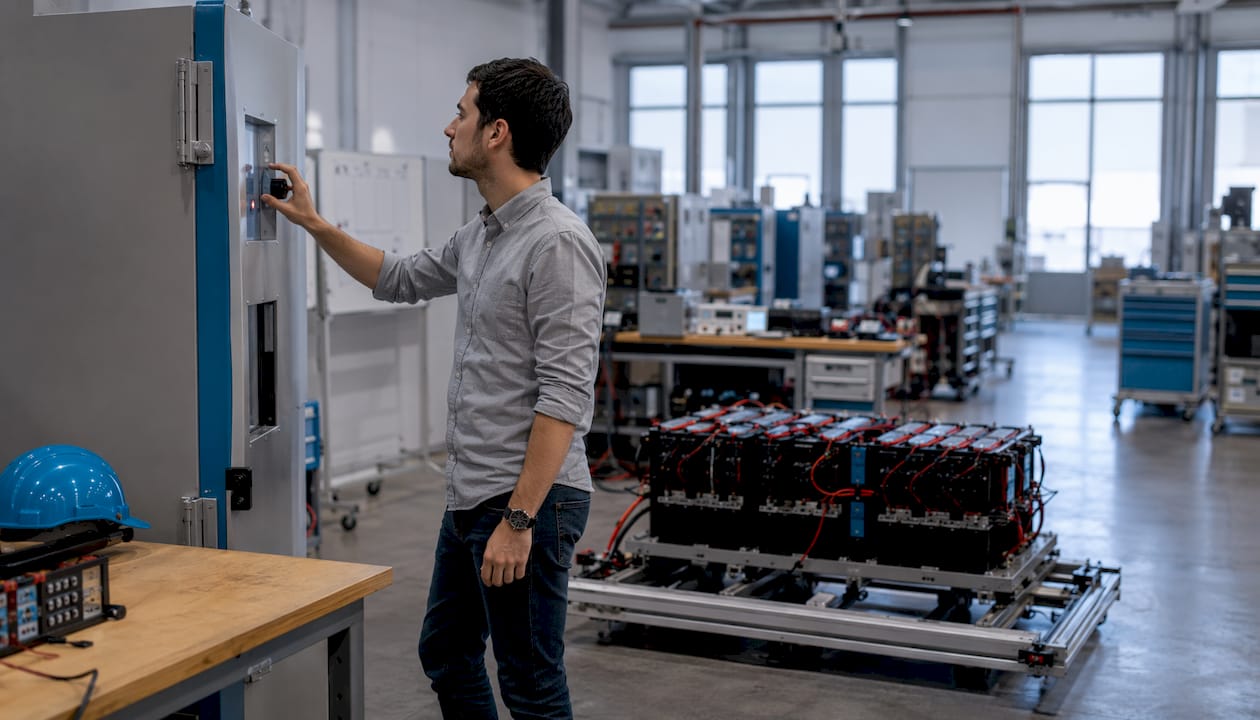
Depth of Discharge: Deep discharges are the fastest way to shorten cycle life. Every time you drain a battery to near zero, the mechanical stress on the electrodes and the chemical strain on the electrolyte are at their maximum. Operating conditions like depth of discharge are among the most influential factors in battery aging, and shallower discharge cycles consistently extend cycle life across all chemistries.
Temperature: Heat accelerates every chemical reaction inside a battery, including the ones that degrade it. Temperatures above 25°C speed up aging measurably. Cold temperatures reduce performance temporarily but cause less long-term damage than sustained heat. Storing or operating a battery in a hot garage, engine bay, or direct sunlight shortens its cycle life faster than almost any other single factor. The effect of cold on motorcycle batteries is a related concern covered in detail for winter storage scenarios.
Fast Charging: Fast charging at C-rates above 1C accelerates degradation even when the charger stays within rated voltage limits. The reason is lithium plating: at high charge rates, lithium ions deposit on the anode surface as metallic lithium rather than intercalating properly into the graphite structure. That plated lithium is largely irreversible and reduces both capacity and cycle life.
Battery Chemistry and Cell Quality: Lower-quality cells use cheaper electrode materials that degrade faster under cycling stress. Two batteries with identical rated cycle lives can perform very differently depending on manufacturing consistency and material purity.
Battery Management System (BMS) neglect: The BMS is the electronic guardian of cycle life. It manages cell balancing, prevents over-discharge, and monitors temperature. Ignoring BMS warnings or bypassing protection circuits leads to premature failure, often dramatically shortening the battery’s usable life.
How to extend your battery’s cycle life in practice
Most of the strategies that extend cycle life come down to reducing stress on the battery’s electrodes and electrolyte. None of them require expensive equipment.
- Avoid deep discharges. Aim to recharge before the battery drops below 20–30% capacity. For LiFePO4 batteries, staying above 20% DoD can dramatically extend total cycle count.
- Keep temperatures moderate. Store and operate batteries in environments below 25°C when possible. If your powersport vehicle sits in a hot garage all summer, consider a shaded or climate-controlled storage spot.
- Use the right charger. A charger matched to your battery chemistry applies the correct voltage profile and avoids overcharging. Overcharging stresses the cathode and accelerates capacity loss. Bansheebatteries offers chargers designed specifically for lithium and AGM chemistries to maintain the right charge profile.
- Avoid routine fast charging. Reserve high-rate charging for when you genuinely need it. Everyday charging at a moderate rate preserves electrode structure far better over hundreds of cycles.
- Keep the BMS functional. Never bypass or disable the Battery Management System. Heed any low-voltage or temperature warnings before they become a failure.
- Follow proper storage procedures. If storing a battery long-term, charge it to the recommended storage level (typically 50–60% for lithium) and keep it in a cool, dry location. Detailed guidance on LiFePO4 storage practices covers the specifics for lithium chemistries.
- Monitor regularly. Periodic capacity checks reveal early degradation before it becomes a reliability problem.
Pro Tip: If you use a battery for marine or powersports applications seasonally, a maintenance charger (also called a trickle or float charger) during the off-season prevents self-discharge damage and keeps the battery in the optimal state of charge without overcharging it.
For AGM batteries specifically, the maintenance habits are somewhat different from lithium. A guide to maintaining AGM batteries correctly walks through the key differences in charging and storage requirements.
What research reveals about battery degradation at the chemical level
The visible symptom of cycle aging is capacity loss, but the underlying causes are more complex than a single mechanism.
SEI Layer Growth: In lithium-ion cells, a solid electrolyte interphase (SEI) layer forms on the anode surface during the first few cycles. This layer is actually protective initially, but it continues to grow with each cycle, consuming lithium inventory and increasing internal resistance. As internal resistance rises, the battery delivers less power to high-demand loads even when the capacity indicator still reads near 100%.
Electrode Particle Cracking: Repeated expansion and contraction of electrode particles during charge and discharge causes mechanical fractures over time. These cracks expose fresh electrode surface to the electrolyte, triggering further SEI formation and accelerating capacity loss. This is one reason why mechanical strain and SEI growth can limit power delivery before full capacity loss is obvious.
Lithium Plating: Fast charging causes lithium ions to deposit as metallic lithium on the anode rather than intercalating into the graphite. This plated lithium is electrochemically inactive and permanently reduces the battery’s lithium inventory. It also creates safety risks, since metallic lithium can form dendrites that pierce the separator between electrodes.
Capacity vs. Power Fade: Cycle aging affects two distinct performance dimensions. Capacity fade is the gradual reduction in total energy stored. Power fade is the reduction in peak current delivery, driven by rising internal resistance. A battery can retain acceptable capacity while losing the ability to start a high-compression engine or power a trolling motor at full speed. Both matter, and cycle life ratings do not always distinguish between them.
Research on lithium-ion degradation mechanisms identifies loss of lithium inventory, active positive electrode material degradation, and active negative electrode material degradation as the three primary loss modes. Understanding which mode dominates in a given application helps engineers and informed users choose the right chemistry and usage strategy.
Statistic callout: Energy throughput measured in MWh is increasingly used alongside cycle count as a longevity metric for storage systems, because it captures the actual work done across variable discharge depths rather than treating every cycle as equivalent.
Bansheebatteries builds for cycle life from the ground up

Bansheebatteries designs AGM and LiFePO4 batteries specifically for the high-cycle demands of powersports and marine environments. Their lithium marine batteries carry a 5-year warranty, reflecting the cycle durability that LiFePO4 chemistry delivers in real-world conditions. AGM batteries come with a 4-year warranty, backed by over 20 years of manufacturing experience in demanding applications.
Whether you need a battery that survives hundreds of weekend trips on the water or a powersport battery that handles cold starts and vibration season after season, Bansheebatteries has the chemistry and the engineering to match. Explore the full range of lithium powersport batteries to find the right cycle life for your application.
Key Takeaways
Battery cycle life is the most reliable predictor of how long a battery will serve you before replacement, and it is directly shaped by chemistry, discharge depth, temperature, and charging habits.
| Point | Details |
|---|---|
| End-of-life benchmark | Industry standard sets end of cycle life at roughly 80% of original capacity remaining. |
| Partial cycles count | Using 75% one day and 25% the next equals one complete charge cycle. |
| LiFePO4 leads on longevity | LiFePO4 batteries commonly exceed 2,000 cycles, far more than standard lithium-ion or lead-acid. |
| DoD and temperature are the biggest levers | Shallower discharges and temperatures below 25°C extend cycle life more than any other single factor. |
| BMS protection is non-negotiable | Bypassing or ignoring Battery Management System warnings accelerates premature battery failure. |