


What Causes Battery Sulfation and How to Stop It
Sulfation is the buildup and hardening of lead sulfate crystals on a battery’s lead plates, and it’s the single biggest reason lead-acid batteries die early. It happens mainly because of chronic undercharging, long storage at a partial state of charge, high heat, and acid stratification, all of which stop the normal charge/discharge chemistry from fully reversing.
Every lead-acid battery forms lead sulfate every time it discharges. That’s normal chemistry, not damage. The trouble starts when the battery sits discharged or partially charged for too long, giving those soft sulfate crystals time to harden into a stable form that a regular charger can no longer dissolve. Once that happens, the plate area available for the reaction shrinks, and the battery loses capacity permanently.
The fastest way to keep this from happening comes down to three habits:
- Keep it topped up. Recharge fully after every deep discharge instead of leaving a battery sitting at 50% or lower.
- Use float or maintenance charging during storage. A trickle or smart charger holds voltage in the safe zone and prevents self-discharge from dragging the battery into sulfation territory.
- Control the temperature. Heat speeds up self-discharge and crystal growth, so store batteries somewhere cool and shaded whenever possible.
Key Takeaways
Chronic undercharging, long idle storage, high heat, and acid stratification cause lead sulfate to harden on battery plates, and prevention through full charging beats any recovery attempt.
| Point | Details |
|---|---|
| Primary causes | Chronic undercharge, partial-state-of-charge cycling, long idle storage, high heat, and acid stratification drive sulfation. |
| Soft vs. hard sulfation | Soft sulfation often reverses with a full charge; hard, crystallized sulfation usually does not. |
| Top prevention habit | Recharge fully after every discharge and use float charging during any storage period. |
| Replacement triggers | Case swelling, persistent high internal resistance, or failure to hold specific gravity after a recovery attempt mean it’s time to replace. |
| Chemistry alternative | Bansheebatteries offers AGM batteries backed by a 4-year warranty and LiFePO4 batteries that avoid the sulfation failure mode entirely. |
Table of Contents
- Types of Battery Sulfation: Reversible vs. Permanent
- What Causes Battery Sulfation in the Real World
- How to Tell if a Battery Is Sulfated
- The Real Cost of Sulfation on Battery Performance
- Preventing Battery Sulfation: A Practical Checklist
- Can You Actually Reverse Battery Sulfation?
- Why Some Sulfation Never Comes Back: The Chemistry Behind It
- Safety and Disposal for Sulfated Batteries
- A Technician’s View on Sulfation in Powersport and Marine Batteries
- When Replacement Beats Recovery
- Sources
Types of Battery Sulfation: Reversible vs. Permanent
Not all sulfation is a death sentence, and that distinction changes what you should do next. Battery techs generally split it into two categories: soft (reversible) sulfation and hard (permanent) sulfation, as explained in detail in Solar Battery Options: Tips for Homeowners.
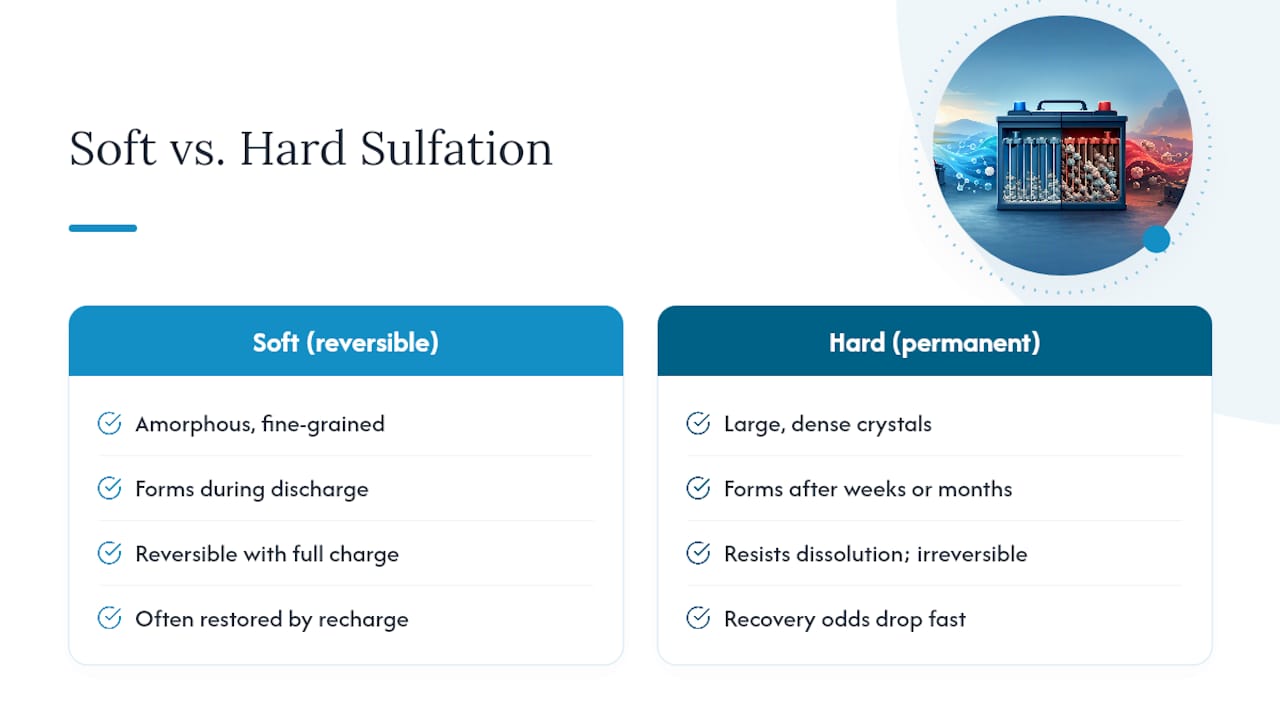
Soft sulfation forms an amorphous, fine-grained layer of lead sulfate on the plates. This is the normal byproduct of discharge, and under a proper full charge cycle, it converts back into active lead and lead dioxide without much trouble. If you catch a battery early, before it’s spent weeks or months sitting low, a full recharge often restores most of its usable capacity.
Hard sulfation is a different animal. Left in place long enough, that soft sulfate slowly recrystallizes into larger, denser crystals that insulate the plate surface and resist dissolving even under a strong charge. According to the Wikipedia entry on desulfation, this conversion from amorphous to stable crystalline lead sulfate is the core reason some batteries never come back no matter how long you charge them.
The practical takeaway: if a battery has been sitting discharged for a few days, a full charge usually fixes it. If it’s been sitting for months, or it’s an older battery that’s cycled through this pattern repeatedly, you’re likely dealing with hard sulfation. At that point, recovery odds drop fast, and safety becomes the bigger concern. Pushing high current into a hard-sulfated battery generates excess heat and gas rather than useful chemical conversion.
What Causes Battery Sulfation in the Real World
The chemistry is straightforward. During discharge, the lead plate (negative) and lead dioxide plate (positive) both react with sulfuric acid in the electrolyte, producing lead sulfate on both plates and releasing electrons as current. On charge, that reaction runs backward: lead sulfate converts back into lead, lead dioxide, and sulfuric acid. Sulfation happens when that reverse conversion doesn’t complete, and the leftover lead sulfate lingers long enough to harden.
Several field conditions push a battery into that failure mode:
- Chronic undercharging or partial-state-of-charge (PSOC) operation. Batteries that never see a full charge, common in marine and powersport applications where short trips don’t allow a complete recharge cycle, build up sulfate a little more each cycle. Research on VRLA battery aging identifies PSOC operation as the dominant driver of accelerated sulfation and capacity loss.
- Long idle storage without float charging. A battery sitting in a garage or boat over winter self-discharges gradually, and if nothing tops it back up, it drifts into the sulfation zone within weeks.
- Repeated shallow cycles without a full recharge. Charging to 80% and discharging repeatedly, without ever letting the battery finish a full cycle, has the same effect as chronic undercharging.
- High ambient temperature. Heat accelerates self-discharge and speeds up the crystal growth that turns soft sulfate into hard sulfate.
- Low electrolyte level or exposed plate tops. In flooded batteries, plates left uncovered by acid sulfate faster and unevenly.
- Acid stratification. Electrolyte can settle into layers, with denser, more concentrated acid pooling near the bottom and weaker acid near the top. Technical writeups on lead-acid failure modes point to stratification as a localized accelerant, since the bottom of the plates sulfates faster than the top.
- Mismatched or poorly tuned charger settings. A charger that never reaches absorption voltage, or one that cuts off too early, leaves the battery chronically undercharged even though it “looks” finished.
Pro Tip: *Depth of discharge (DoD) matters as much as how often you charge.
How to Tell if a Battery Is Sulfated
Sulfation rarely announces itself with a single obvious symptom. It shows up as a cluster of small performance complaints that get worse over weeks or months.
Watch for reduced runtime under load, charge times that stretch longer than they used to, a battery that seems to charge but won’t hold voltage once you disconnect the charger, or a starter battery that cranks slower each week. In powersport and marine applications, this often shows up first as sluggish cranking in cold weather, since sulfation and low temperatures compound each other.
If you suspect sulfation, work through the diagnostic steps in order, safest first:
- Visual inspection. Check the case for bulging or cracking, and check vent caps for corrosion or acid residue. Skip any further testing if you see swelling or leakage.
- Rest voltage. Let the battery sit disconnected for a few hours, then measure open-circuit voltage.
- Specific gravity (flooded batteries only). A hydrometer reading well below a fully charged range across all cells, or wide variation between cells, points to sulfation or stratification.
- Load test. A battery that reads fine at rest but collapses under load has classic sulfation or internal resistance symptoms.
- Internal resistance or impedance test. Where a shop meter is available, sulfation shows up as elevated internal resistance compared to a healthy battery of the same type.
| Test / Metric | Healthy Range | What Sulfation Looks Like |
|---|---|---|
| Storage voltage (12V lead-acid) | At or above 12 volts | Below 12 volts for extended periods |
| Specific gravity, full charge (flooded) | Roughly 1.265 to 1.299 across cells | Consistently low or uneven readings between cells |
| Behavior under load | Stable voltage during load test | Rapid voltage sag under load |
| Charge acceptance | Reaches absorption voltage in normal time | Charger runs unusually long or never reaches target voltage |
Storage voltage and temperature guidance above draws on manufacturer recommendations for preventing sulfated batteries.
Safety first: lead-acid batteries produce hydrogen gas during charging, especially near the end of a charge cycle. Charge in a ventilated area, away from open flame or sparks, and never test or charge a battery that’s hot to the touch, swollen, or leaking. If a battery gets hot during a recovery charge or you smell strong sulfur, stop immediately and let it cool. Sealed VRLA and AGM batteries should never be opened. When in doubt, hand it to a professional shop.
The Real Cost of Sulfation on Battery Performance
Sulfation doesn’t just shorten a battery’s life. It changes how the battery behaves at every stage of use, and the effects compound over time.
- Capacity loss. Sulfated plates have less active material exposed to the electrolyte, so usable amp-hours drop even when the battery still “holds a charge” by voltage alone.
- Increased internal resistance. Reviews of lead-acid sulfation tie sulfation directly to rising internal resistance and falling electrolyte acid concentration, both measurable signs of the same underlying problem.
- Voltage sag under load. A sulfated battery can look fine at rest, then drop sharply the moment you ask it for real current.
- Longer, less complete charging. Chargers take longer to reach absorption voltage, and some sulfated batteries never fully get there.
- Higher operating temperature. The added resistance generates more heat during both charge and discharge.
- Plate damage and shedding. Long-term hard sulfation can physically weaken the plate structure, leading to active material flaking off and permanent capacity loss.
Picture a starter battery on an ATV that cranked fine every weekend last season. Left in the garage over winter without a maintenance charger, it self-discharges, and by spring it either won’t crank at all or cranks weakly before dying mid-season. Or think about a deep-cycle marine bank that used to run the livewell pump all day and now taps out by early afternoon. Both are classic sulfation stories, not sudden failures.
Sulfation rarely acts alone. It tends to accelerate corrosion at the grid and plate connections and can worsen plate cracking, since a resistive, partially insulated plate runs hotter and stresses the grid structure more with every cycle. That’s part of why sulfated batteries often fail faster than their calendar age would suggest.
Preventing Battery Sulfation: A Practical Checklist
Prevention is cheaper and far more reliable than any recovery attempt, and it’s mostly a matter of habit rather than equipment.
For batteries in regular service:
- Recharge fully after every significant discharge rather than leaving it “good enough.”
- Avoid stringing together repeated shallow cycles without an occasional full top-up charge.
- Match your charger’s profile (bulk, absorption, float) to the battery chemistry and size instead of using a generic setting.
- Set charge voltages according to the battery manufacturer’s spec rather than a one-size-fits-all number.
For batteries in storage:
- Bring the battery to a full charge before storing it, never store it discharged “to save the charge.”
- Connect a float or maintenance charger for anything sitting longer than a few weeks.
- Store in a cool, dry space. Heat above roughly 75°F meaningfully speeds up self-discharge and crystal growth.
- Check and top up voltage periodically rather than assuming a float charger needs zero attention.
| Parameter | Typical Guidance |
|---|---|
| Float voltage (12V lead-acid) | Charging voltage varies depending on chemistry |
| Storage temperature target | Below roughly 75°F |
| Equalization (flooded cells only) | Periodic controlled overcharge per manufacturer schedule |
| Storage check interval | Every 4 to 6 weeks minimum |
Pro Tip: If you run a flooded lead-acid bank hard, in a boat, an off-grid setup, or a backup power system, schedule a controlled equalization charge on a regular interval rather than waiting until performance drops. It mixes stratified electrolyte and helps knock out early-stage sulfate buildup before it hardens.
Each of these steps maps to a specific mechanism. Temperature control slows crystal growth directly. Float charging counters the slow self-discharge that otherwise drags a resting battery into PSOC territory. Full recharges after use give the reverse chemical reaction time to finish, instead of leaving a residue of lead sulfate to harden overnight.
If you’re storing a vehicle or boat seasonally, a guide to preventing off-season battery drain walks through the wiring and parasitic-load side of the problem, which matters just as much as the charger you use. AGM owners specifically benefit from chemistry-specific maintenance practices, since AGM cells handle overcharge and equalization differently than flooded lead-acid.
Can You Actually Reverse Battery Sulfation?
Here’s the honest assessment: soft sulfation often responds to a slow, controlled charge. Hard, crystallized sulfation usually does not, no matter what a charger’s marketing claims.
If you want to attempt recovery on a battery you suspect has early-stage sulfation, follow this sequence:
- Inspect first. Rule out case damage, swelling, or leaks before applying any charge.
- Charge at low, constant current over an extended period. A slow charge, well below the battery’s typical bulk-charge rate, gives more time for lead sulfate to convert without generating excess heat or gas.
- Monitor temperature continuously. Stop immediately if the case gets warm to the touch.
- Track specific gravity or voltage rise. Technical guidance on battery sulfation recovery recommends watching per-cell voltage and specific gravity during a recovery charge, and stopping if readings plateau without improvement over several hours.
- For flooded cells, consider a controlled equalization charge, but only within the manufacturer’s voltage and duration limits, and never on a sealed AGM or VRLA battery.
- Reassess after the charge. Run a load test. If capacity and voltage stability haven’t meaningfully improved, the sulfation is likely permanent.
Commercial pulse “desulfator” devices claim to break down hard sulfate crystals using high-frequency pulses. The honest picture, per the Wikipedia entry on desulfation, is that independent, peer-reviewed verification of these claims is limited, and results reported by users vary widely. Treat these devices as unproven rather than as a guaranteed fix.
Replace the battery instead of chasing a recovery when you see any of the following: visible case swelling, internal resistance that stays high after a full recovery attempt, specific gravity that won’t rise to a normal range across all cells, or any sign of gassing and overheating during a normal charge. At that point, a safe DIY deep-cycle reconditioning approach can help you decide whether it’s worth the time, but pushing a compromised battery past these warning signs risks thermal runaway or acid leakage.
Why Some Sulfation Never Comes Back: The Chemistry Behind It
The reason hard sulfation resists charging comes down to two linked processes: incomplete regeneration during charge, and crystal growth over time.
Mass-transfer limits within the plate structure, combined with gas-evolving side reactions that consume charging current, mean that charging often can’t fully convert all the lead sulfate back to active material. That leftover fraction is what accumulates and hardens.
Mechanistic modeling of lead-acid battery failure shows that as a battery charges, some of the applied current gets diverted into hydrogen and oxygen gas evolution rather than the sulfate-to-lead conversion reaction, particularly as voltage climbs near the end of the charge. That diverted current means a portion of lead sulfate simply never converts back on a given cycle.
Left in place, that residual sulfate undergoes a process similar to Ostwald ripening, where smaller crystals dissolve and redeposit onto larger ones over time, since larger crystals are more chemically stable. The practical result is fewer, bigger crystals rather than many small ones, and bigger crystals present less surface area for the charging reaction to work on. That shrinks the plate’s effective active area and raises electrode resistance with every cycle it’s left untreated.
This is why depth of discharge and charging protocol matter more than any single “miracle” fix. A battery cycled shallow and recharged fully every time gives the reverse reaction the best possible chance to finish before crystals have time to grow. A battery left at PSOC for days or weeks gives those crystals exactly the conditions they need. Commercial pulse desulfators claim to disrupt this crystal structure electrically, but the underlying mass-transfer and gas-evolution limits described in the modeling work above suggest why results are inconsistent between batteries, applications, and devices.
Safety and Disposal for Sulfated Batteries
Testing, charging, and attempting to recover a sulfated battery all carry real hazards, and disposal comes with its own rules.
- Wear eye protection and acid-resistant gloves any time you’re testing specific gravity or handling a battery with visible corrosion.
- Charge and test in a ventilated space. Hydrogen gas released during charging is flammable and can accumulate in enclosed areas.
- Keep sparks and open flame away from a charging battery at all times.
- Monitor case temperature during any recovery charge attempt and stop if it exceeds what feels comfortably warm to the touch.
- Never open a sealed VRLA or AGM cell. There’s no serviceable access inside, and doing so releases pressurized gas and acid.
- If a battery is leaking, cracked, or emitting a strong sulfur smell, stop working on it and isolate it until you can dispose of it properly.
A dead or unrecoverable lead-acid battery should never go in household trash. Most auto parts retailers and battery specialty stores accept old batteries for recycling, often at no cost, and hazardous waste facilities in most areas take them as well. Lead and sulfuric acid are both environmentally hazardous if they leak from an improperly disposed battery, and most states have specific regulations governing lead-acid battery disposal and core exchange. Check your local rules before assuming a standard trash pickup will take it.
A Technician’s View on Sulfation in Powersport and Marine Batteries
Sulfation shows up constantly in seasonal-use equipment, and it’s almost always preventable. The pattern in powersports and marine gear is remarkably consistent: a battery gets parked for the off-season without a maintenance charger, and by the time it’s needed again, it’s either weak or dead. This isn’t a defect in the battery. It’s a predictable outcome of how these vehicles get stored.
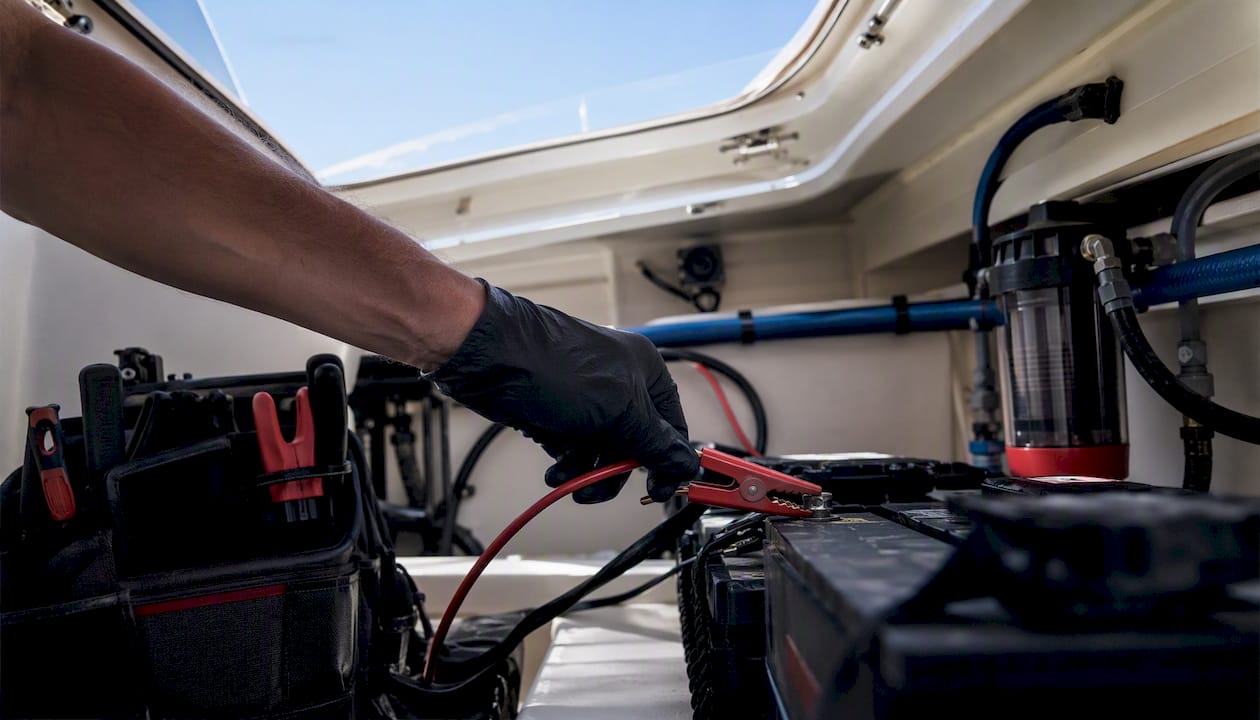
For AGM owners, the biggest lever isn’t some exotic recovery trick. It’s matching the charger to the chemistry and actually using it during storage months. AGM batteries tolerate float charging well and punish neglect quickly, since their sealed design means there’s no topping off electrolyte to buy back lost performance. For LiFePO4 owners, the calculation is different: lithium chemistry doesn’t sulfate in the way lead-acid does, so the maintenance conversation shifts from “prevent sulfation” to “avoid deep discharge and extreme temperature,” which is a genuinely lower-maintenance proposition.
Be honest with yourself about DIY desulfation attempts. A slow charge on an early-caught, lightly sulfated battery is worth trying. Pouring hours into a battery that’s been sitting dead for a season, showing swelling, or failing to hold a load test afterward isn’t worth the risk of thermal runaway or a ruined charger. For anything powering critical equipment, a boat’s bilge pump, a UTV you rely on for work, get a professional load test before you trust it again.
When Replacement Beats Recovery
If a battery is genuinely hard-sulfated, the safest and most cost-effective move is replacement, not another recovery attempt. Bansheebatteries builds AGM and LiFePO4 batteries specifically for powersports, marine, and RV use, backed by a 4-year warranty on AGM and 5-year warranty on lithium marine batteries, so you’re not gambling on a battery that’s already fighting its own chemistry.
If sulfation keeps coming back on the same battery, the real fix might be a charging setup that prevents it in the first place. A fully automatic maintenance charger with overcharge and short-circuit protection holds your battery in the right voltage range automatically, so you’re not relying on memory to catch it before it drifts into PSOC territory. And if you’re tired of fighting sulfation altogether, switching chemistry is a legitimate long-term option: Banshee lithium marine batteries and lithium powersport batteries don’t rely on the lead sulfate reaction at all, so the entire failure mode this article covers simply doesn’t apply to them. Before switching, check fit against your vehicle or vessel’s electrical system, and reach out to Banshee’s support team if you’re unsure which capacity or terminal configuration matches your application. Browse the full battery lineup to compare AGM and lithium options side by side, and get your replacement ordered before the next season catches you with a battery that won’t crank.
Sources
- Desulfation (Wikipedia)
- Sulfation in lead–acid batteries (ScienceDirect review article)
- Mechanistic modeling of sulfation and failure in flooded lead–acid batteries (IOPScience article)